

High Touch Onboarding
A Guide for Technical Founders


You did it! Someone signed up for your solution! That is epic! Now you have to answer the question: what is this user's journey as they onboard to your offering?
Onboarding is critical no matter what kind of sales motion you use. It’s the first real impression the customer will have of your product and organization after the sale closes.
You cannot let them down at this point nor introduce any unnecessary friction. Simply stated, if they don’t end up onboarding, they do not use the product, and they do not renew the service. In fact, a poor onboarding experience is the third most common reason for not renewing. Additionally, customers are 50% more likely to stay loyal to a solution that has a smooth onboarding process. The two data points above point to the critical nature of a smooth onboarding for building a long term relationship (ideally with many renewals!) with your customers.
Renewals are critical to SaaS companies and affect metrics such as ‘Net Dollar Retention’ (i.e., ‘NDR’), which is your ability to keep customers on your service and expand them into a larger spend with you. Best-in-class companies have an NDR of over 100%, sometimes up to 110%. This means that each customer, on average, is spending 10% more with you every year.
Renewal-related metrics become a focal point for future fundraising efforts.
Onboarding can broadly be broken up into two large groups, ‘high touch’, and ‘low touch’. In some cases you can also mix high and low touch styles for the same product, depending on the size of the contract/customer.
High-Touch
In this post we’re going to explore ‘high touch’ onboarding; what it is, and how to think about it. In a future post, we’ll look at ‘low touch’ onboarding.
In general, high-touch onboarding is reserved for two things:
Products that require deep integration with existing systems that cannot be done in a self-service way OR that require guidance/troubleshooting help due to complexity
High-paying customers for a self-service style product who have purchased an ‘enterprise’ version of said product
Some examples of high touch onboardings include products that: interact with services within a customers infrastructure, must be deployed into the customer infrastructure, require complex permissions to run against customer systems, have outsized consequences if they are misconfigured, or require a lot of customization to be useful for a customer.
Think of services like ZScaler, much of Palo Alto’s offerings, SAP/Oracle solutions, anything on-premise, or even CDN solutions (where a misconfigured DNS record could be catastrophic). Similarly, if you’re an AI startup and need access to sensitive data from a customer, you may need to have team members who can guide a company through opening up this data in a secure way to your tooling.
Products that require high-touch onboardings also require staff to do this onboarding, which means the pricing must support this need for headcount. At scale, many organizations will have a pre-sales technical specialist, an onboarding specialist, and a post-sales technical specialist. The technical specialists are typically paired with an Account Executive to close the business and a Customer Success / Account Manager to relationship manage during onboarding and afterwards.
That is up to five people for every customer who is onboarded! Of course each person will cover many customers but you need to ensure your product is priced sufficiently high to eventually reach a desired ARR / role. For example, a Customer Success / Account Manager may make financial sense if they look after 4 million in ARR. Once they hit 4 million, you may need to increase the headcount for the function. Each role will have a different ‘magic number’, and the number will vary by organization.
The other large category of high touch onboarding is an Enterprise version of a product with a self service offering. In this case you are kind of ‘inventing’ a need for a high touch onboarding to really differentiate the Enterprise tier of service. You are trying to identify the use cases and feature requirements that are a strong signal for Enterprise service vs. self-service service. Alternatively, this customer may hit a volume of use that you use as an indicator that they must purchase the Enterprise service.
While the customer could likely use the self-service version purely from a configuration/ease of use perspective, their usage, some specific feature need, or their desire for an account team / better support is driving them to Enterprise.
Examples include FIPS use cases (required for contractors / US government entities), access to specialists who can help with small customizations, or other specific features that ‘tip their hand’ that they are a large enterprise (perhaps localization or data sovereignty requirements / strong OIDC integrations / etc).
Finally, focusing on white glove service can be a powerful lever here. While not all customers will care about being able to talk to someone on the phone, for a type of Enterprise buyer, this will really matter. It’s very likely your self-service and Enterprise offerings will share more than they differ. Services, like support and account management, can be the difference maker here.
Understanding the ‘trip wire’ for pushing a self service customer to the Enterprise offering (and a much bigger spend with you) is more of an art than a science. You need a deep understanding of what use cases your customers use your solution for AND which of those use cases are indicative of ‘true’ Enterprise usage. In our experience, heavy identity, permissions, regulatory, and volume-based use cases are a good fit for most companies to trigger a conversation with the customer about using the Enterprise version of your solution.
It’s important that the use cases you define are so obvious and clear to your users that they do not feel pushed to pay for a more expensive service. Customers with these use cases should understand the value that Enterprise brings and have real requirements for the features, in addition to receiving evaluated support.
The flowchart below can help you:
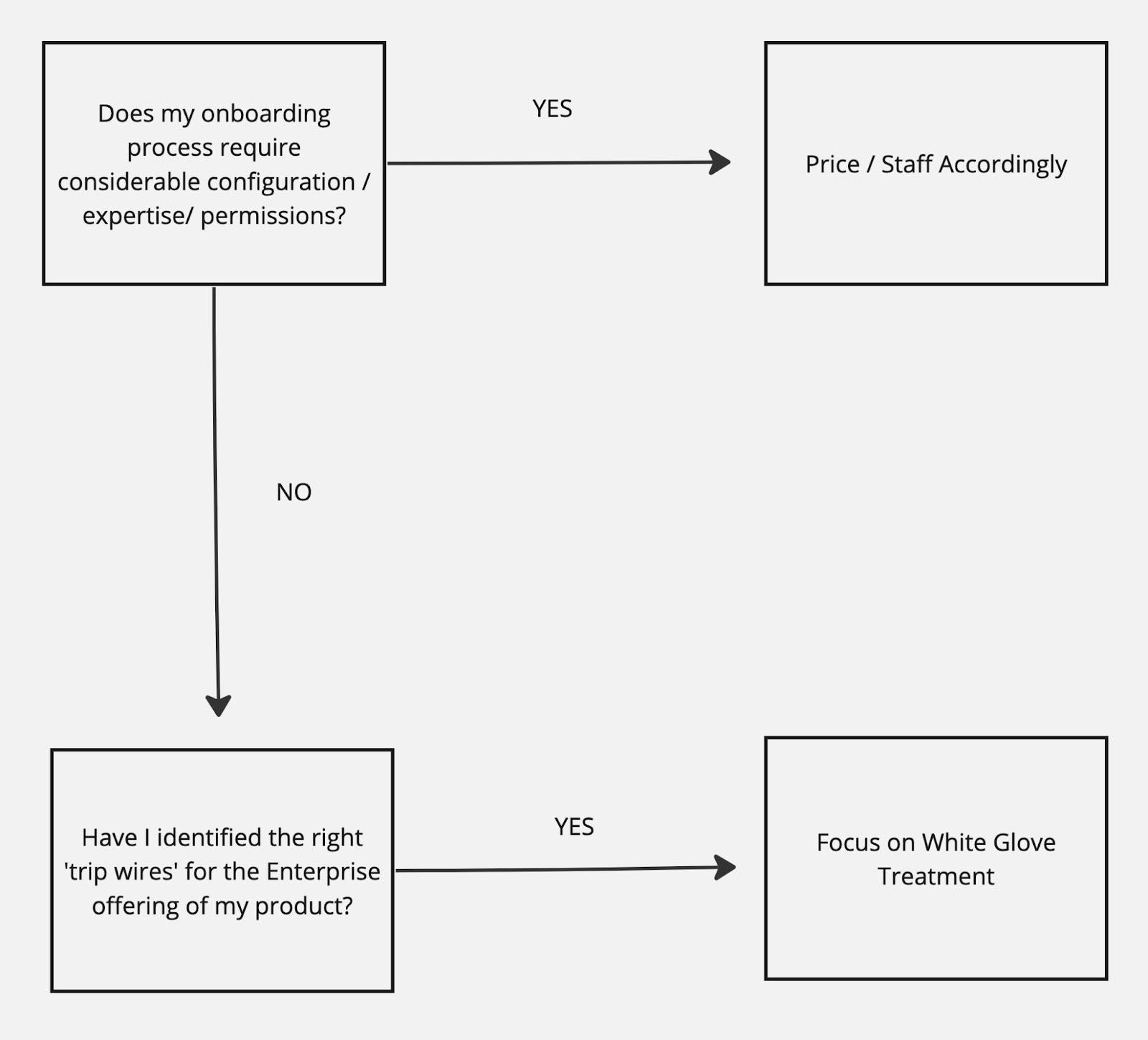
Need help understanding how to onboard customers to your products? Is it ‘high touch’ or ‘low touch’? Do you have the ‘trip wires’ defined for your Enterprise tier? Levitate can help!
Frequently Asked Questions
How Do I Measure Onboarding Success?
The success of an onboarding process can be gauged through a combination of qualitative and quantitative metrics. Key Performance Indicators (KPIs) such as Time to First Value (TTFV), where the focus is on the duration it takes for a new customer to achieve their first significant outcome with the product, and Activation Rate, which measures the percentage of users who reach a defined milestone that indicates they are getting value from the product, are crucial. Additionally, Customer Satisfaction Scores (CSAT) and Net Promoter Scores (NPS) provide insight into the customer's qualitative experience and likelihood to recommend the product. A comprehensive assessment involves tracking these metrics from the onset of onboarding to identify areas of friction, gauge the effectiveness of the onboarding process, and iterate for continuous improvement.
What Are The Cost Implications of High-Touch vs. Low-Touch Onboarding?
The choice between high-touch and low-touch onboarding strategies carries significant cost implications. High-touch onboarding, while more resource-intensive due to the need for personalized support and dedicated staff, is often justified for complex products or high-value customers where the potential Lifetime Value (LTV) of the customer can offset the initial cost. On the other hand, low-touch onboarding relies more on automated processes, digital tutorials, and self-service resources, making it cost-effective and scalable for a broader customer base. The decision between these approaches should consider the complexity of the product, customer expectations, and the company’s financial capacity to support ongoing personalized engagement. An effective cost-benefit analysis, factoring in the expected impact on customer retention, satisfaction, and expansion revenue, will guide startups in choosing the most suitable onboarding strategy.
How Can I Transition Between Onboarding Types?
As startups grow and evolve, so too do their onboarding needs. Transitioning between onboarding types—whether from low-touch to high-touch in response to offering more complex products or addressing a higher-tier customer segment, or vice versa to scale operations—requires careful planning and execution. The key is to maintain a customer-centric approach, ensuring that changes enhance, rather than disrupt, the customer experience. This involves clear communication about the changes, retraining staff as necessary, and possibly updating technological infrastructure to support new processes. Continuously gathering feedback during and after the transition can help identify any issues early on. Moreover, leveraging data to understand customer behavior and preferences will ensure that the onboarding experience remains aligned with their needs and expectations, facilitating a smooth transition.

If you’d like help setting up, managing, or optimizing your onboarding flow, let us know! We’d love to hear more.